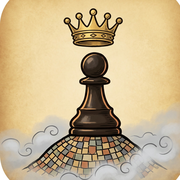
 Pawnborn
The world
Every rule in Pawnborn is something a grieving referee half-remembers how to do. That is not a flourish laid over the game — it is where the rules came from.
The Board, and the breaking of it
Long ago the world was one seamless land — the Great Board — and on it two immortal courts, Ivory and Onyx, played an eternal game. But no game plays itself. Between the two courts stood a third power, older than either: the Arbiter, the living spirit of the game, born the moment the first rule was ever agreed upon. It kept the clocks, weighed the ranks, and held both courts to equal ground — for that was its whole nature and its only hunger: a game is only real if it is fair.
When their final game ground into a stalemate neither would accept, the courts did the one unforgivable thing. Rather than concede, they shattered the Board itself. Both courts died in the breaking. The Arbiter did not — a spirit of law cannot die while anyone, anywhere, still keeps a promise — but it was wounded past healing, and it dissolved into what the folk now call the Veil: the grey, grieving mist that fills every gap of the broken world.
Why the Veil has laws — the Veil is a law
The Veil is not a place. It is the Arbiter, everywhere and half-asleep, doing forever the only four things it remembers how to do:
It raises fair courts
Judging contests was its purpose. When two armies meet, the mist rises around the battlefront and shapes what it finds there into the one form it trusts: equal ranks, equal clocks, a game. Soldiers become pieces because that is how the Arbiter has always seen soldiers.
It carries what is won
The Board must someday be whole again, and the Arbiter believes — perhaps wrongly — that every fairly-won tile moves the world one square closer to mended. So conquered land visibly lifts, drifts, and sets itself into the victor's border.
It hides what is unwatched
An unwatched game cannot be judged. Where no eyes keep the land — no border, no tower, no lit hearth — the mist simply stops pretending the land is there.
It keeps what was broken
The shattered pieces of the dead courts are its dead, and it will not give them up. They drift in the deep mist — colossal, mournful, wrong — and the folk call them the Sundered. Fighting one is fighting the Arbiter's grief, and grief does not fight fair.

The Pawnborn
The folk of this world are the Pawnborn — descendants of the pieces, mostly of pawns, because pawns were always most of any army and outlived their masters in the breaking. Their founding truth, the sentence every child learns first, is "no one in the Mosaic is born a knight."
Everything in their world is built on that promise: the training yards, the promotion rites, the structure of their republics, and the plain fact that a soldier broken in battle and sent home without rank is not finished — they are a pawn again, and every pawn may rise.
The Great Mosaic
Sovereigns rebuild the world outward from their keeps, tile by tile, on one endless expanse: the Great Mosaic. It grows the way a mosaic must — outward from its first surviving fragment in a slow spiral, because that is the direction the Arbiter drifts as it lays won and woken tiles into place. There are no separate servers and no other worlds. Where two republics sit in that spiral is real distance, and an army has to walk it.
Why the world is warm
The art direction is warm illuminated manuscript: parchment light, iron-gall ink, gilded rank-lines, banners and heraldry. The myth is melancholy — the world is a grieving referee's half-dream — and the present is hopeful, because the Pawnborn are winning it back one square at a time. Nothing here is grimdark. The people in this world lost everything once and got up.
There is a working rule behind that tone: if a mechanic cannot be told as something the Arbiter or the Pawnborn would actually do, we treat the mechanic as suspect. It is a surprisingly good filter for bad design.