 Pawnborn
The game
The kingdom decides where, when, at what stakes and how prepared. The chessboard decides who wins. Everything in Pawnborn sits on one side of that line or the other.
A kingdom that runs on real hours
Your territory is a mosaic of tiles won back from the mist, and it grows two ways: your scouts walk out and wake new land, or you take it from a neighbour. Farms feed people, quarries cut stone, barracks turn citizens into soldiers, walls and watchtowers make a border expensive to cross.
All of it runs in real time — the world's clock rings once an hour, and things take the hours they take. Nothing here demands that you sit and watch it. The design budget is roughly ten minutes a day to keep a healthy kingdom in order, and there is deliberately no way to automate your way past that, for you or for anybody else.
An army made of people
Soldiers are not a resource bar. Any citizen may walk into the barracks and come out a soldier; soldiers gather under named banners with service records that outlive them. When a battle forms, each piece on the board is one of those regiments, standing in the line.
That is the part that changes how the chess feels. A rook is not a rook — it is a regiment with a name, and losing it costs you people you will have to replace. Half of those lost come home eventually, stripped of rank, to begin again as pawns. Even in this, nobody is finished.
Attacks that take hours and arrive when you choose
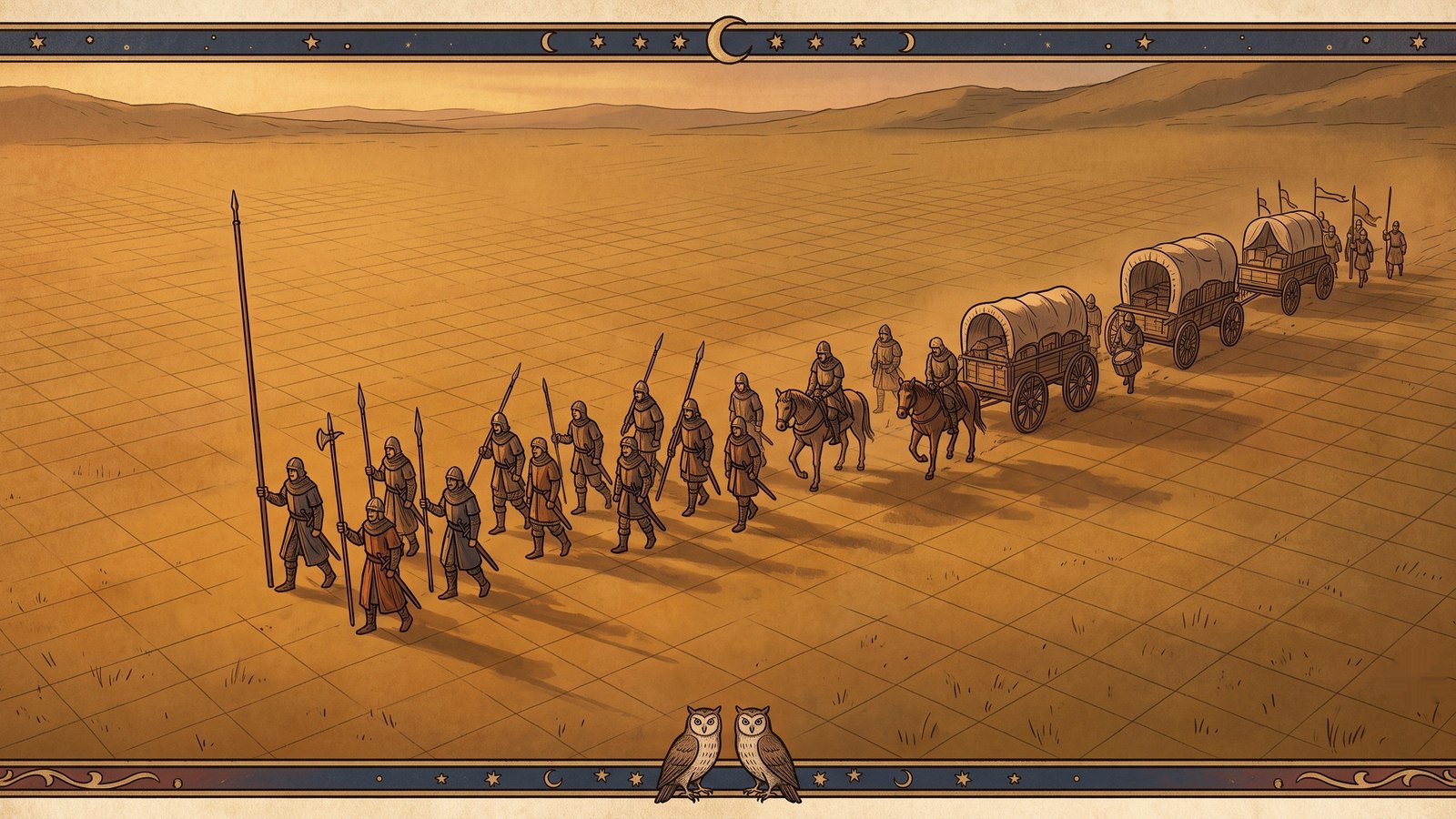
There is no teleporting army and no surprise from a clear sky. You commit a column, and it marches — for hours — toward one slice of a neighbour's border. You pick the hour it arrives, so battles land when their owners are awake. If the defender built watchtowers, they see you coming; if they did not, they learn at the gates.
When the column arrives, the armies do what armies have always done: they camp. Banners go up, terms are read out, and there is a window of time in which either commander may take the field. Then the mist rises, and the battle is a game of chess.
If you are asleep, you do not simply lose
Someone will attack your border at four in the morning. This is a game about a persistent world, and that is going to happen. So your defence fights for you: your own army, in your own formation, at your own strength.
What absence costs you is everything around the result — glory, the faith of your own people, and any movement of your chess rating, because a game with a machine in it never counts toward anyone's rating. What it does not cost you is the game itself. You are allowed to have a life.
Sixteen crowned equals, one table
Up to sixteen players swear an oath together and become a republic — one full side of the old board. A republic has no king; its leader merely chairs. Everyone joins as a pawn, and every officer's chair is filled by promoting one, because a game whose motto is no one is born a knight should keep the promise at its own council table too.
Republics go to war with one another, one at a time, watched by the world. Wars are ended by diplomacy rather than by a timer — there is a running measure of who is winning, and its only job is to price the peace.
Everybody's game is a real game
Half of Pawnborn ignores your chess rating entirely: growing a territory, running spies, exploring, holding a seat at a council, organising a war. And the half that is chess is sized to you — the board a battle is fought on is chosen to protect the weaker hand, automatically, with nothing to configure and nothing to know.
A player who loses half their games should still be having a good time. If they are not, we treat that as a bug in the design rather than a fact about them.
This page describes the shape of the game, not its rules — the detailed systems are still being built and tested, and we would rather show them working than describe them working. Join the notify list to see them first.