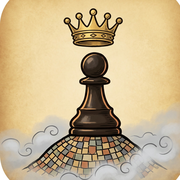
 Pawnborn
Why build a chess MMO at all?
Chess is played by hundreds of millions of people. Strategy MMOs are played by millions more. The overlap is nearly empty, and empty overlaps are usually empty for a reason — so the first real work on Pawnborn was spent trying to find out which reason applied.
The two failure modes
There are two obvious ways to combine chess with a kingdom game, and both are bad.
The first is to make the chess decorative — a minigame you tap through on the way to a resource bar. Chess players spot this in about ninety seconds and leave, correctly, because the chess is not real and nothing about it matters.
The second is to let the kingdom leak onto the board. Your barracks give you an extra pawn; your treasury buys you a tempo; the whale opens with two queens. This is the version that gets built most often, because it is the obvious way to make a kingdom feel powerful, and it destroys the one thing chess has that nothing else does — the certainty that the position in front of you is honest.
The line we drew
So Pawnborn draws a hard line and refuses to cross it. The kingdom decides where you fight, when you fight, what is at stake, and how prepared you are. The chessboard decides who wins. Power is real and worth having — it just never expresses itself as material, tempo, or clock.
That constraint turned out to be generative rather than limiting. Once the board is untouchable, every interesting question moves outward: which border is thin, whether their watchtowers saw you coming, whether the defender will be awake, whether your spy's report was a lie somebody planted. Those are strategy-game questions, and they can be as rich as you like without ever putting a finger on the scale of the game itself.
Why the pieces are people
The other half of the answer is what a piece is. In Pawnborn each piece on the board is a regiment — a hundred souls with a name and a service record the world remembers. Losing a rook is losing the Greyfile Third, and their families will hear of it.
This does something we did not fully expect until we played it. It does not change a single rule of chess, and it changes how a trade feels entirely. Sacrificing material for position is a familiar idea; sacrificing material that has a name is a decision you sit with for a second longer. Chess is already dramatic. Giving the pieces provenance costs nothing and turns the drama into a story you can tell afterwards.
The hard part is the ordinary player
The genuine difficulty is not chess players. It is everybody else. Most people are not good at chess, and a game where the skilled reliably crush the unskilled has an audience of a few thousand.
So a great deal of the design is spent making the game work for someone who loses half their games: matching battles to skill automatically, keeping the consequences of a loss gentle and recoverable, and making sure that a large share of the game — territory, spying, exploration, running a republic, organising a war — has nothing to do with chess rating at all. A player who will never beat a strong opponent should still be able to be genuinely important to sixteen people.
Whether we have managed it is exactly what a small invite-only world is for. The notify list is here.