 Pawnborn
Where the name Pawnborn came from
Naming a game is mostly a search problem wearing a creative hat. The name has to mean something, it has to be sayable, it has to be free to use — and then it has to be findable, which is the requirement that quietly eliminates most of the good ones.
What the name had to do
Four things, in this order:
- Be ownable. A name we could clear and register, not a common word with forty prior users in the same class.
- Be searchable. Typed into a search box, it should return us and nothing else. Descriptive names fail this immediately.
- Say what the game believes. Not what it contains — what it is about.
- Survive being said out loud by someone who has only read it, and being spelled by someone who has only heard it.
Why not something descriptive
The tempting names were all descriptive — some arrangement of chess, kingdom, realm, war, gambit. Every one of them is a disaster to find. A game called anything plus "Chess" is competing for that word with six hundred years of literature and a thousand apps. You do not win that. You simply become invisible inside it.
The working title for a long time was a Latin-flavoured word we liked a great deal and could not clear — a trademark sweep found it heavily used, including in software. That was the right kind of disappointment to have early rather than late.
Pawn, and born
The game's central belief is stated inside its own fiction, in the first sentence every child of that world learns: no one in the Mosaic is born a knight. Everything is built on it — soldiers rise through the ranks, a broken knight comes home a pawn and may rise again, every officer at a republic's council table was promoted from the ranks, and a pawn that reaches the far side of the board becomes a queen who wears a small pawn's mark at her base forever, so that everyone can see what she was.
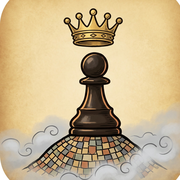
Pawnborn is that sentence compressed into a word. It names the people — descendants of the pieces, mostly of pawns — and it names the promise: born a pawn, and not bound to stay one.
It also happens to be structurally useful. It is one word, three syllables, stressed on the first. It contains "pawn", so a person who has never heard of us can guess within one word that chess is involved. And it did not previously exist, which means that in time it can mean exactly one thing.
The cost of a coined word
Coining a word has one real drawback, and we are living in it right now: for a while, nothing finds it. A search engine that has never seen a word does not conclude that it is a new word — it concludes you have misspelled an old one, and helpfully shows you something else entirely.
That is a temporary problem with a boring solution: exist, in public, consistently, until the word has a meaning attached to it. This page is part of that work. So is the fact that we always write it the same way, one word with a capital P — Pawnborn.
If you have arrived here having searched for something else, welcome. We are the chess kingdom one. Here is what it is.